motorobilia.jpg (12807 bytes)
64_cantplease1.jpg


Thursday, January 22, 2009

Geithner: Comprehensive Restructuring, Substantial Change in Detroit
Gettlefinger: Define Restructuring

UAW president Ron Gettlefinger was "out of pocket" yesterday. He flew back to Detroit yesterday from President Obama's inauguration, and when he got home he did what most Detroiters have been doing for the past month. No, he didn't check the Internet or cable news for the latest bad tidings about the auto industry. He shoveled some snow. This winter of discontent in Detroit has been a very snowy one. After clearing out his driveway the head of the UAW drove downtown to speak to the Automotive News World Congress at the RenCen Marriott. So when Mr. Gettlefinger addressed the AN shindig last night, he hadn't heard Treasury Secretary designate Timothy Geithner remarks in his confirmation hearings in the Senate yesterday afternoon.

Geithner said that any further financial aid to the domestic automakers is contingent on major changes.

"Any assistance the government provides is assistance in support of a comprehensive restructuring that will leave the industry in a stronger financial position where they can be profitable and healthy without government support… That's going to require very, very substantial changes by all stakeholders."

"Comprehensive restructuring", and "very, very substantial changes" might scare a union official of fainter heart but regardless of what Geithner said, Gettlefinger is hoping that with Democrats in control of Washington, the "stakeholders" that he represents won't have to take "too big of a hit."

In his remarks to the AN world congress, Gettlefinger said, "We know that additional sacrifices may be required to get these companies back on track. But all stakeholders will have to participate. Any attempt to single out one group to bear the brunt of the changes needed within our industry will fail, because no one group can solve the problem alone."

One of the things that hurt the Detroit automakers during the congressional hearings in November and December was the fact that the UAW gives millions of dollars in campaign funding and political assistance to Democrats. The UAW's chickens came home to roost when the Senate Republicans had the power to kill the congressional loan package. Gettlefinger didn't get to be president of the UAW by being a bad negotiator. Now he's expecting that the UAW's money was well spent and business as usual in Washington will spare his members from major concessions, no matter what Geithner said on Capital Hill.

During his address Gettlefinger said that "UAW members are optimistic about working with the new congress." I don't want to say that the fix is in, and I'm not sure if the Vegas books will take any action on legislative activity, but if I was a betting man…

After the speech, a reporter from Detroit's WDIV TV news asked the UAW chief about Geithner's remarks calling for change and restructuring. The Obama nominee has worked for Treasury or the Fed for most of his adult life, so he's no naif in the ways of Washington, but Gettlefinger is going to school him on the way things really work in the nation's capital.

Regarding "restructuring", Gettlefinger said, "I'm not sure exactly what that means at this point in time, and I didn't hear it… I missed out on the hearings today but again a lot of times people make statements and then when they look at the facts it's a lot different."

Gettlefinger no doubt figures that Obama is in charge, not his Treasury secretary, and that the newly sworn in president and a Democratic Congress will by sympathetic to the UAW. Concerning Obama, the UAW president said, "He knows and we know that a strong manufacturing base, including a strong domestic auto industry, are vital to the future of the U.S. economy."

From what chairman of the House finance committee Rep. Barney Frank, D-MA, said, Gettlefinger is right. Frank, who has been a vocal critic of the concessions demanded of the UAW in the Bush administration's loan package, was speaking on the occasion of a largely symbolic House vote reaffirming the loan conditions. Frank said, "I'm sure Obama will change those."

Regarding those conditions, the deadline for GM, Chrysler, their creditors and the UAW to come up with a plan that Congress will consider viable is February 17th. Theoretically, if the benchmarks aren't met the government will pull the loans already granted, which would mean immediate bankruptcy.

When asked if the details can be hammered out in less than a month, Gettlefinger said, "I think we can be ready… it's going to be a push on the time." Like I said, Ron's a great negotiator. He had a failsafe loan from President Bush in his back pocket when playing hardball with Senators Corker and Shelby. He now knows that he can dig his heels in negotiating with GM & Chrysler between now and Feb. 17th and a Democratic congress and President Obama will back him up.

Labels: , , , ,


Read More & Comment

Wednesday, January 14, 2009

GM & Ford Are Testing Consumers For Blowback On Government Loans

The North American International Auto Show (NAIAS) in Detroit, with thousands of reporters present, is a unique opportunity for company executives to get their message out. Or, in the case of Toyota president Katsuaki Watanabe this year, avoid the NAIAS and a barrage of questions about Toyota's first fiscal loss in 70 years.

When the CEOs do attend, the drill is usually the same. After the product introductions and press conferences, company personnel are available on the stand for questions and photographs. If you're high enough up in the media pecking order PR folks will schedule private interviews, but for most journalists the press conferences are the only chance to ask an honest question. Whether you get an honest answer is a different story.


Even though there's access, it's still a challenge. After the reveals, reporters and photographers are invited up to the stage. Concentric circles of reporters, cameramen and audio operators with their sound booms quickly surround CEOs and high profile execs. By the time the crowd thins out enough to try to get in a question, the executives' PR handlers are busy hustling them out. This year, with all the attention paid to the domestic automakers' troubles, the crush of reporters was even greater than normal. The crowds were so deep that you'd be lucky to get a photo of the top of Rick Wagoner's or Alan Mulally's head. If you strained you could hear their answers, which is great for background but not very helpful if you're pursuing a particular angle for a story.

On advantage of the NAIAS is that it takes place in Detroit, headquarters of the domestic automakers. Besides their CEOs most of the other high ranking executives are at the show. If you can't get close to a CEO, there are presidents and VPs aplenty. At the GM event I waited patiently while GMNA president Troy Clarke explained to the Automotive News that GM's focus would be on the Chevrolet, Buick, Cadillac and GMC brands and that they were in "daily talks" with their Saturn dealers. Not exactly a good omen for the Pontiac and Saturn nameplates. When it was my turn I mentioned consumer blowback over the government loans, that people are saying they won't "pay GM twice" and will boycott their products. I asked Clarke that since Rick Wagoner alluded during the congressional hearings to testing consumer reaction to a Chapter 11 bankruptcy, did GM also test how consumers would react to a government bailout? Was the decision to ask for loans based on a less negative consumer reaction to government assistance than to a bankruptcy?

Clarke avoided addressing government loans as the lesser of two evils in terms of consumer reaction. He did, however, say, regarding consumer blowback over the loans, "we are testing for that now." If you notice, GM did not follow Chrysler's example of spending millions on 'thank you America' newspaper ads. No doubt GM is aware of the overwhelmingly negative reaction to those ads and is treading gently with its marketing efforts.

Over at the Ford display there was more evidence that Ford "gets it". After the press conferences were over, while GM was sequestering its executives in private interview booths, Ford had them out in their display schmoozing reporters. To be sure, there was always a PR minder within earshot, just in case the wrong question got asked, but the easy access to Ford executives did not go unnoticed. Jim Farley and Jennifer Flake are doing their jobs well.

Mulally was busy doing tv interviews, but Mark Fields, Ford's president for North America was available. First I asked him about the consumer blowback that GM and Chrysler now face and if Ford's decision to avoid, for now, asking for money from the Feds was influenced by consumer testing on that issue. Fields, who is as slick as they come, went into spinmeister mode. He said that they do focus group testing on a weekly basis and continuously monitor the Internet for consumer reaction. Though he avoided directly answering my question, my impression is that FoMoCo knows very well that many consumers are negatively reacting to bailing out Chrysler and GM. While Ford has publicly supported those loans to their competitors, there's no question that they want consumers to distinguish them from the other domestic automakers.

At the same time that Ford wants to distinguish itself from GM & Chrysler, it wants to be sure that Uncle Sugar isn't treating them like a stepchild. I asked Fields if Ford thinks that GMAC getting access to additional TARP funds gives GM an "unfair competitive advantage". He replied that Ford Credit was structured differently than GMAC, which is now a bank holding company. Fields said that Ford had no plans to turn Ford Credit into a 'bank' to be eligible for TARP funding, but that Ford would not "want to be disadvantaged".

Fields' and Clarke's answers illustrate the tightrope walk the domestic automakers must maneuver. They must take the steps they feel they must take in order to survive. At the same those actions carry the risk of negative consumer reaction. Wagoner, Mulally, Fields, Clarke et al are well compensated. Their jobs, though, are such a headache these days that you couldn't pay me enough to do them.

Labels: , , , , , , ,


Read More & Comment

Wednesday, December 31, 2008

Most memorable ride of the year (decade?)

As many of you know who have seen me replying on other sites, I am somewhat of a car nut (massive understatement). Therefore, you would likely assume that the most memorable ride in a vehicle this year would be in one that I actually drove -or at least rode in the front seat, right?

Amazingly enough, not so! And it wasn't in an ultra high horsepower vehicle or one with outstanding handling prowess or any of the other class leading attributes that I would normally value (and I had rides in a few of those as well). The ride lasted maybe five minutes, never got over about 15 mph, there were no high dynamic maneuvers - and I rode in the back seat!

I don't know how many of you are familiar with the DARPA challenge - it was not covered much by the MSM in this country, although in many other countries it was highly covered.


Essentially, the DARPA challenge is to have a vehicle that can drive by itself - no operator, no remote control. Maneuvering is done by utilizing downloaded GPS intermediate co-ordinates to one or more high horsepower computers; there were ten duo-cores in all, then using various sensors like radar and lidar, as well as digital cameras, the vehicle (essentially a gas powered robot at this point) is given a start command and goes about the tasks involved to get to each GPS checkpoint. While following all traffic laws, including speed limits, stop signs and traffic lights. In a city environment with traffic that consists of other robots, human driven vehicles and obstacles.

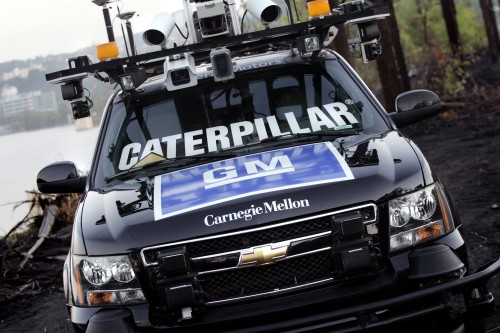
And I got a ride in the vehicle that won!! By twenty minutes! How cool is that? The winning team, Tartan Racing, led by the Carnegie Melon University Robotics Institute, had three major development partners, GM, Caterpillar and Continental, all of whom had resident engineers at Carnegie Melon throughout the program. I was asked by one of the partners if my company would like to become a sponsor and provide some development assistance. Our senior management thought about that for maybe five seconds and said "absolutely".

As a sponsor, we were invited to come to a special event that was held at the GM Technical Center in Warren, Michigan. We met several of the key people from Carnegie Melon, had an extremely interesting technical presentation by Professor Red Whittaker - a fascinating gentleman to talk to then off to the parking lot to get a close up look at the winning vehicle - and get a ride.

In the vehicle front seat were two Tartan Racing team members. We were told to buckle up, they pulled out an E-Stop button and we were off. The Boss (hugely modified Chevy Tahoe) named after Boss Kettering as in Kettering University put itself into drive, and started driving around the perimeter of the parking lot. We came to a stop sign which Boss stopped at and waited its turn while another vehicle entered the lot. Then Boss weaved through a number of cones (that were moved several times during the demonstration) came back to the beginning position, parked, and turned off.

Now,I have been involved with high technology for a great deal of time and have seen and helped develop a lot of fun stuff over the years, but this to me was, WOW time! The sheer level of technology and innovation involved in this winning effort is simply astounding.

If you are interested in learning more about this I encourage you to visit:

http://www.tartanracing.org/

Labels: , , ,


Read More & Comment

Thursday, December 18, 2008

Rick Wagoner doesn't make $15.7 million a year

Rick Wagoner doesn't make $15.7 million a year. Last year he took home $3.5 million. $1.5 million in salary, another $1.8 million in bonuses and about $200,000 in benefits and taxable perks. The BOD justified/rationalized the bonus based on the $9 billion or so he took out of costs and the successful launches of the CTS and Malibu. That's their rationale, not mine. You can read it in GM's proxy statement in the investor relations section of their web site. It's in their SEC filings. The rest of the 15.7 mil is in stock options and other performance related items that didn't have any value last year and won't have any value in the foreseeable future. Stock options only have value if the market share exceeds the option price.

While reading GM's proxy statement, I came across how much they pay members of the BOD. GM has, I believe, 11 members of the board, all of them outside of the company except for Wagoner, who's Chairman. Board members are paid $200K a year in director fees plus other compensation. In 2007, the board voted itself a 25% pay cut, so salaries for the board were $1.5 million, and with other compensation, GM paid less than $2 million to it's board.

By contrast, Toyota recently announced they they were cutting the bonuses paid to their BOD, which amounted to $11 million in last year. Total compensation to the board in fiscal year '08 was $37 million.

Toyota has 30 members of it's BOD plus 7 auditors. Unlike GM, which has an outside BOD, nearly everyone on Toyota's board works for the company. There are two Toyoda family members on the board (just like at Ford, btw). I don't know if the figure bandied about for "Toyota's top 32 executives" who make less than Mulally or Wagoner or whoever is independent of their compensation as members of the BOD, or is part of that $37 million, but the fact remains that Toyota pays its BOD members and auditors more than 5 times what GM pays its board members.

When board members of Toyota are raking in a million a year, Wagoner's base salary of $1.5 million doesn't look excessive.

Labels: , , , ,


Read More & Comment

Sunday, November 30, 2008

No Wonder the Detroit CEO's Were a PR Disaster in DC
Look @ Their Advertising

Even defenders of the domestic auto industry have panned the Detroit CEOs' performance in Washington. The same companies that environmentalists attack for having lobbied to stall CAFE regulations now seem impotent in Washington, scorned and mocked, rather than respected or feared. Worse, in a world with C-SPAN and YouTube they did an appalling job of public relations during the congressional hearings. It shouldn't surprise us, considering the state of their advertising.

I don't know who is more at fault, the car companies or their advertising agencies, but for decades, the Detroit car companies haven't seemed to be able to make commercials that can tout their "new and improved" products without reinforcing the negative impact previous models have made on consumers, or worse, giving their competitors positive publicity, or yet even worse than that, make their own customers look like idiots.

This isn't a recent phenomenon. For years, dating back to the mid 1980s, Ford tried to recover market share lost to the Japanese brands with "Have you driven a Ford lately?" ad campaign.


"We used to build crap cars but, honestly, we're competitive now, really, so check us out, please?"
Actually, it wasn't just a slogan, Ford had an entire jingle written for the campaign.


Ford eventually retired the slogan, but old insecurities die hard and they reprised the slogan and updated the music for their full-line ads for the 2007 model year. Someone in Dearborn must really like the slogan because they produced both a short form version

and the extended play version:


There are echoes of it to be found in their "Drive One" marketing campaign, started earlier this year. One part of that campaign features ads titled "Ford asks people to Drive One" with people who hadn't considered Ford products but were impressed after extended test drives. One of them has a potential car buyer saying, "There's a little skepticism going forward because, well, Ford doesn't have the best name as far as reliability goes."


While it's admirable for Ford to acknowledge reality, I'm not convinced that reminding your customers about your bad reputation for quality is how you change that reputation.

That insecure mindset must be deeply ingrained in Dearborn. Ford can't even tout good news without sounding like, "hey, what about us? We make good cars now too." After recent data showed Ford being in a statistical dead heat with Toyota (and Honda) in terms of initial new car quality they started running commercials saying pretty much that - only they shot themselves in the foot by saying that Ford has quality equal to Toyota, mentioning their competitor by name. Everyone already knows that Toyota is the gold standard of quality so why mention them? Also, saying you're as good as the competition doesn't really do much to convince people to switch to your product. If you're only as good, why should consumers switch? It seems to me that saying "Ford has industry leading quality" (without a "now" in there) gets the improved quality information to potential customers without mentioning either Ford's prior poor reputation nor would it enforce Toyota's already stellar reputation in consumers' minds.

Insecurity must be contagious in Detroit. Saturn, arguably the GM brand with the best consumer reputation, has been trying to widen its appeal beyond folks who frankly, don't like cars that much. Two years ago, to highlight Saturn's expanded lineup, Saturn's ad agency, Goodby, Silverstein & Partners, produced a commercial around the tag line, "That's a Saturn?", with people expressing surprise when they see the Aura, Sky and Vue.

The agency must have thought didn't have enough edge, so they also shot, for online distribution, a R-rated version, "That's a $%&^ing Saturn?", using the same actors.

Find more videos like this on AdGabber

With or without profanity, the message was the same, "we don't make just boring cars anymore." Just like Ford and quality, the ad simply reminds people about boring cars Saturn has sold. It's also derivative of the 70's vintage "That's a Matador" ad from AMC.

[Matador ad is @ 2:35]
Considering the level of the Matador's success, I'm not sure that's a good thing.

While "That's a Saturn?" didn't appreciably increase showroom traffic or sales, it's another mistake from which GM apparently hasn't learned a thing. With manufacturers and dealer groups running seasonal end of year sales, GM is now running ads announcing Saturn's "Red Tag" event. A customer steps into a Saturn store, glances at a Sky roadster and a Vue compact SUV, looks surprised and steps back out of the showroom to look at the Saturn sign. He returns to the showroom and asks, "These all…?" and the saleslady says "Saturn? You got it! Happens a lot lately," with her male counterpart chiming in, "People do that", followed by a voiceover saying, "Meet the new Saturn, at the Red Tag event."

Humorous? Yes. Clever? Perhaps. Will it sell Saturns to people who hadn't considered them before? I doubt it. Will it make current Saturn owners think that GM is calling them dorks? Perhaps not, but only because they probably don't pay any attention to car commercials. They are, after all, that segment of GM's customer base that doesn't really care about cars other than as an appliance.

Advertising that makes fun of customers does happen to be a pet peeve of mine. Chrysler excels at that. I can understand Durango ads implying that men are idiots who don't ask for directions and who'd never be able to function without wise, all-knowing wives. So many commercials follow that misandrist theme that Chrysler's not unique. Women make about 80% of consumer purchases. However, even the very popular and successful "That thing got a HEMI?" Dodge Ram truck campaign took a swipe at loyal customers. The knuckle-dragging rubes asking that question, played by actors Jon Reep and Todd Giebenhain, drive a ratty looking 30 year old Duster with a hood scoop.

Why have them driving a MOPAR product? If they're going to get smoked by the guy with the HEMI, might as well have them drive a competitors product, maybe a really rusty 70s vintage Corolla.

At one of the media previews I asked some Chrysler marketing folks about that swipe at old MOPAR guys, but I got the same blank looks as when I asked the Mitsubishi folks why they used an Iggy Pop song about sex hustlers, drugs and booze for the music in their commercials. Maybe advertising cluelessness isn't restricted to Detroit.

If the Detroit manufacturers want to let consumers know that it's not business as usual, they should build superior cars and tell people about what makes them superior. Apologizing for poor products in the past or saying that you're just as good as the competition isn't going to end the red ink or increase market share. Humor has a place in advertising. So does comparison with competitors. However, if Detroit is truly interested in changing the way they do business, they need to take a hard critical look at all elements of how they make and sell cars, including how they advertise.

Labels: , , , , , ,


Read More & Comment

Wednesday, November 26, 2008

How the Corvette, Muscle Cars and the Small Block Chevy Helped Destroy Alfred Sloan's Dream

Libraries, or whatever replaces them as we move farther into the digital age, will be filled with books and essays about what went wrong at GM, whether it survives or not. One of the things that industry analysts and car enthusiasts alike frequently point to is GM's many brands and how GM diluted those brands and ended up with 7000 dealers competing with each other. How GM got all those brands, starts with William Crappo Durant. Billy Durant created General Motors, starting with Buick in Flint, MI, and then going on a buying spree. The car companies he bought included Oldsmobile, Cadillac, Elmore, and Oakland (later renamed Pontiac). He also bought truck manufacturers Reliance Motor Truck and Rapid Motor Vehicle that in time became GMC Trucks. Acquiring all those car and truck companies created a lot of debt, though, and he lost control of GM and left the company. He went back to Flint, started Chevrolet with the Chevrolet brothers to compete with his former backers, and with the help of the DuPonts was able to take control of GM again and bring Chevy into the GM fold.

Enter DuPont. It's impossible to discuss the history of General Motors without mentioning the DuPont family and the DuPont company. To this day, DuPont and GM continue a close business relationship. As diversified a company as DuPont is, with its wide range of product that touch almost everything people use, GM may still remain DuPont's one single customer, directly or through tier 2 suppliers. DuPont sells huge amounts of plastics and paint to car companies across the globe, but a GM bankruptcy would hurt DuPont hard. DuPont has at least a dozen people in Troy, Michigan working full time submitting invoices to GM's electronic purchasing system. I know that because I worked at that site for 21 years, including the last six years in IT, supporting those folks. At any one time, GM owes DuPont many millions of dollars for paint and plastics, and GM's supply chain owes huge sums to DuPont as well. I'm no accountant, but it seems to me that the loss of those accounts receivables in a GM bankruptcy would immediately affect DuPont's bottom line.

DuPont is a 200 year old company and calls itself a "science company" these days. Most people still think of it as a chemical, paint, and plastics company. That's not how it started out. In 1802 a young Frenchman named Eleuthere Irenee du Pont de Nemours came to Delaware and built a gunpowder mill. He got his big break when he started selling his product to a young enterprise called the federal government of the United States of America. Business was good to both the public and private sector. There was a frontier to settle, and battles to fight, not to mention the export trade. I assume the DuPont family developed a fine sense for the winds of war and in 1914 Pierre DuPont bought stock in GM, watching it increase in value sevenfold during WWI. WWI was the first war that used trucks, tanks and cars instead of horses. After the war, flush with profits and expertise in and pyroxylin chemistry from experience with nitrocellulose explosives, the DuPont company developed new quick drying high gloss paint. In 1910, DuPont had acquired Fabrikoid, a company that coated fabric with nitrocellulose to make artificial leather and in 1915 also bought a company making a pyroxylin plastics. DuPont was reinventing itself. With its expertise in things explosive, DuPont could see that the young automobile industry was exploding and that it needed the new paints, plastics and films that DuPont was developing. General Motors had huge potential both as an investment and as a customer for DuPont. The DuPont company invested $25 million in GM stock (eventually owning 43% of GM stock), wrested control from Durant, and brought in Alfred P. Sloan to run the company. Sloan was so successful that DuPont would later reorganize itself to Sloan's corporate governance model. In the late 1940s and into the 1950s antitrust action forced DuPont to divest General Motors, but as mentioned the relationship between the two companies endured.

Pierre DuPont and Alfred P. Sloan brought order to what had been a profitable, but chaotic General Motors. It's generally acknowledged that it was Sloan's idea to take the many GM companies and have a brand for each price point, from entry level Chevrolets to luxurious Cadillacs. As he put it in the report to GM stockholders in 1924, "a car for every purse and purpose". Today we think that GM has too many brands but for much of GM's history Sloan's paradigm worked. It allowed General Motors to sell cars to everyone from a factory worker to a millionaire and become the biggest company in the world. Henry Ford and the Model T may have put the world on wheels, but it was Alfred Sloan who turned the car into an aspirational status symbol.

For much of GM's history, into the 1960s and 1970s, GM's brands were clearly distinguished in consumers' minds and didn't really compete with each other. The brands may have competed around the margins of the price points but that helped GM by creating a ladder so to speak, to the next higher brand. Either way, they bought a GM product. It even gave more affluent families who didn't want to show off less ostentatious but still upmarket options, a Buick instead of a Cadillac. Even as GM moved to sharing platforms across the brands in the 1950s and using some rationalization and economies of scale with components, each brand had unique styling, completely different sheet metal, different interiors, features and even different engines. Into the 1970s, Chevy, Pontiac, Oldsmobile and Buick each had their own, completely different, small block V8 (more on that later).

Harley Earl, legendary GM stylist, worked hand in glove with Sloan, developing each brand's styling and identity. It's ironic that one of Earl's most iconic creations would be the start of the obsolescence of Sloan's model. Earl liked the post WWII sports cars and wanted to compete in that new market segments with the European imports. Most auto enthusiasts see, in the history of the Corvette, one of GM's few indisputable successes. Almost as continuously upgraded as the Toyota Corolla and an outstanding value in terms of performance per dollar, even critics of GM point to the Corvette as how it's possible for GM to do things right with a vehicle and brand down to the current, amazing, $100,000 ZR1.

The problem, though, was that the Corvette upset the apple cart so carefully stacked by Sloan. The first apple to tumble from the cart was price point. The base price of a 1953 Corvette was $3498, heater and radio optional. That was $300 dollars more than a Buick Roadmaster convertible and not much less than a Cadillac Eldorado coupe. This was a Chevy wealthy folks wouldn't mind driving. In fact, it became a status symbol. Price, though wasn't the only problem, the Corvette's high-speed performance also disturbed Sloan's hierarchy. Most people have forgotten that before the mid 1950s, speed was associated with upmarket cars. Cadillac was considered a performance car and competed in the Carrera Pan American race and hot rodders liked Mercurys as exemplified in the popular song, Mercury Blues. At first the Corvette was more of a boulevard cruiser than a hot rod with a 150 HP BlueFlame six and 2-speed Powerglide transmission. A young Jewish engineer from Belgium named Zora Arkus-Duntov saw the newly born 'Vette on display at the '53 GM Motorama in New York and was inspired. Duntov had already, with his brother, designed and sold highly regarded performance aluminum heads for the flathead Ford V8. He sent a letter and a technical paper to Ed Cole, then chief engineer for Chevy, asking for a job. Duntov was summoned to Detroit, ended up putting Cole's new small block V8 in the '55 Corvette and the rest, as they say, is history. Before the Corvette, Cadillacs were GM's fastest cars. After Corvette became a true sports car, Cadillac was no longer the performance king at GM. Ford's introduction of the two-seat Thunderbird in 1955 and Detroit's instinctive need to compete cemented GM's dedication to the Corvette as their performance halo vehicle. Recognizing that sports cars were a limited market Robert McNamara soon turned the Tbird into a luxury car but the Vette remained America's sports car.

GM's unstated policy has been that no other vehicle they make will have a more powerful available engine than the Corvette. When Corvette engines like the LS1, LS2 & the new LS9 have been installed in other GM vehicles, they are almost always slightly detuned. The LS9 has 638 HP in the ZR1 Corvette while the same basic engine in the Cadillac CTS-V has 550 HP.

Ed Cole's masterpiece, the OHV high compression small block Chevy V8 engine, didn't just disrupt Sloan's model with the Corvette. Making V8 power available to the masses gave performance minded customers an alternative from the up-market cars. It also led to horsepower wars with other GM divisions and other manufacturers.

And it came to pass that small block and big block V8 engines became great in number and begat the muscle car. And verily the muscle cars also grew in number, creating strife between brands.

It's hard to say what the "first" muscle car was. An argument can be made that it was the 409 powered '62 Chevy Bel Air Sport Coupe, available with a four speed and aluminum body panels, essentially a factory drag racer. Chevy's increasing performance image cause further damage to Sloan's model, but the real damage was yet to come.

In 1963, GM upper management issued an edict prohibiting the divisions from participating in auto racing. Obviously, GM's sometimes schizophrenic management didn't just start with Rick Wagoner. At the time, the Corvette, small block Chevy and the 409 notwithstanding, Pontiac was the "performance" brand in Sloan's hierarchy. Chevy owners moving up who were more staid bought Oldsmobiles, but Pontiac was the more stylish, more performance oriented brand. That brand image was cultivated with racing, including NASCAR teams and drag racers like the 1963 LeMans Tempest Super Duty Coupe that went for $226,521 on eBay recently. GM's anti-racing edict flew in the face of Pontiac's marketing image and brand identity To maintain Pontiac's image as a performance brand John Delorean and others at Pontiac replaced the small block 326 in the new midsize 1964 Tempest with the 389 from the fullsize Pontiacs and called it the GTO. Even as the GTO shored up Pontiac's performance image, that image was somewhat undercut by the faster and more powerful Corvettes.

Almost simultaneously with the introduction of the GTO, Plymouth was introducing the Barracuda, based on the compact Valiant and available with V8 power, and Ford was rolling out the hit Mustang based on the compact Falcon. The '63 Falcon Sprint had already been available with a 260 V8, so performance versions of the Mustang were inevitable.

It wasn't just actual perfomance. Much of Sloan's model, crafted by Earl, depended on image. Just because true performance was available at lower price points didn't mean that the up-market cars were slow. Affluent customers still wanted powerful cars, even if they weren't interested in the drag strip or street racing. Oldsmobiles with their "Rocket" brand of V8s were not slow cars. My father's 1966 88 had a 425 and a four barrel and could put rubber down as long as you kept your foot in it. Still, the image of Olds and Buick in the late 50s and early 60s was not a performance image. At least, that is, until the muscle car and pony car war of the 1960s crescendoed into the early 70s. Eventually every GM brand had a performance image car.

Chevrolet, as GM's mass market car, had to compete with Ford's Mustang (and to a lesser extent the Barracuda), which virtually overnight had created a huge market segment with a young demographic. Car companies have always liked to establish brand allegiance when consumers are young. The Corvette was too expensive, as were the fullsize 409s for first time or young buyers. The compact Nova, available with V8 power, was not stylish enough. So Chevy developed the Camaro off the Nova platform. To give Pontiac, the "performance" brand, an entry level sporty car priced below the midsize GTO, GM came out with the Camaro's twin the Firebird twin. While the GM pony cars each had distinctive front and rear styling, engines and interiors, they shared so many body lines that they were obviously essential clones. Chevy and Pontiac aficionados may have chosen sides, but to most of the public, the F Bodies were generic GM. The similarity of the Camaro and Firebird continued through each generation until both cars went out of production in 2002.

Markets were overlapping and GM models were getting closer to badge engineering. The late 1960s A Body midsize cars, the Chevrolet Chevelle, Pontiac Tempest, Oldmobile Cutlass and Buick Skylark had more of a family resemblance spread among a wider number of brands than perhaps any other previous GM platform. The muscle car wars and dealer demand for competitive product meant that by 1970, GM was producing four A Body muscle cars, the Chevelle SS 396/454, Olds 442, Pontiac GTO, and Buick GS 455. Brand allegiance was still strong but the brands were now competing directly with each other.

Emissions controls and The Yom Kippur war and subsequent OPEC oil embargo in 1973 meant the end of the muscle and pony car wars. While some of the nameplates remained, or were revived, emissions controls reduced power and made those nameplates parodies of their former selves and further contributed to brand dilution at GM. Even the once great Corvette was humbled in 1975 with a 165 HP engine.

The oil embargo also led to further dilution of Sloan's model. The oil crisis of the early 1970s directly resulted in the downsized GM B Body fullsize cars. The 1977 Chevrolet Impala/Caprice, Buick LeSabre, Olds 88/98, and Pontiac Catalina/Bonneville were design masterpieces, shrinking outside dimensions by 10-15 inches and cutting weight 700-800 pounds without reducing interior space. The styling was crisp, the handling pretty good for such a big car, and the cars did sell well. The problem is that they were virtual clones and obviously badge engineered. Throughout the GM brands, at every price point, GM dealers were now all competing with each other, one way or another, except for, perhaps, Cadillac, ensconced in its luxury status. GM, of course, would screw up Cadillacs image in the early 1980s with the notoriously unreliable early experiment with variable displacement, the V8-6-4, and the compact J-Body Cimmaron.

A much more successful engine, the small block Chevy V8 (I told you I'd get back to it) would drive the final nails in the coffin of "a car for every purse and purpose" model of Alfred Sloan. The 1977 B-Bodies shared platforms and had similar sheet metal. They looked very similar and shared drivetrain and other components. Still, GM looked to cut costs even more. The domestic auto industry had a rough time during the malaise era and cost cutting became vital. It made no sense at all to make so many different engines. Manufacturing four completely different small block V8 engines with virtually identical performance was wasteful, so to smooth production the company started replacing some of the Buick, Olds and Pontiac V8s in the new downsized B-Bodies with the small block Chevy. Fiscally the decision made sense and the bean counters were happy.

The problem is that though GM had been diluting their brands for over two decades at that point, customers still thought the brand names meant something. When Oldsmobile customers took their cars in for service and discovered they had gotten Chevy engines they got angry, having expected an Oldsmobile "Rocket V8". A class action lawsuit was filed, the Olds owners each got $550, costing GM millions and GM got tremendous bad publicity. Ironically, it's not like the customers got a bad engine, as the SBC is about as good as it gets in terms of that era's engine design, but they felt cheated, GM got a black eye, and the fact that its brands were now virtually identical and interchangeable was open to all to see.

Though the customers were placated, the Oldsmobile brand was irreparably harmed. Mishandling the Cutlass brand didn't help things. In fact, the Cutlass may be GM's most bungled brand. While the Cutlass became America's best selling car in 1976, holding that title into the 80s, by 1988, as a result of GM's W Body project and the lingering popularity of the larger Cutlass, Olds was producing four completely different Cutlasses, on four distinct platforms, midsize and compact. It's no wonder that consumers were confused and Oldsmobile eventually died. If GM didn't know what a Cutlass was, how should the consumers?

In 1984 Roger Smith reorganized GM, taking away the divisional autonomy that was a keystone in Sloan's branding scheme. Smiths idea to create a small car division making Pontiacs and Chevys and a large car division making Oldsmobiles, Buicks and Cadillacs, never really worked, caused tremendous upheaval in the company but it did accelerate component sharing, further diluting the brands. Though GM recognized Smith's error (one of many) in creating the small car / big car manufacturing groups, they made the problem worse by consolidating the car brands into one division in 1994. Again, it made fiscal sense, but parts and design sharing across brands had gotten to the point where the cars looked virtually identical. Unfortunately, because of corporate inefficiencies, many of the parts underneath the sheet metal were still different, creating the worst of both worlds- indistinct brands that were expensive to make.

By the start of the 1990s, with the exception of Cadillac, all the GM brands were competing with each other in virtually every market segment. Oldsmobile, Pontiac and Buick no longer had any reason to exist. Their cars were essentially Chevrolets with a bit fancier trim. This may have helped sell some Chevys, but at the cost of lost sales for the other brands. Oldsmobile, which didn't have the performance image of Pontiac to distinguish itself from Buick, was fatally wounded and GM made the decision to kill the brand (at a cost of about $1 billion to pay off dealers) and the last Oldsmobiles were 2003 models.

It's hard to say which was a greater factor in GM's brand dilution, the eventual obsolescence of Sloan's branding model as Americans became more affluent, or GM's own, perhaps unintentional sabotage of that paradigm, even with some of its most iconic and successful cars.

Labels: , , , ,


Read More & Comment

© 2008 Motorobilia

Trademarks are owned by their respective holders. Motorobilia is not affiliated with any vehicle manufacturer.